
Ready to transform your business with Brochure Design?
Contact our expert team today for a tailored strategy and free consultation.
Get a Free ConsultationNo services available in this category yet.
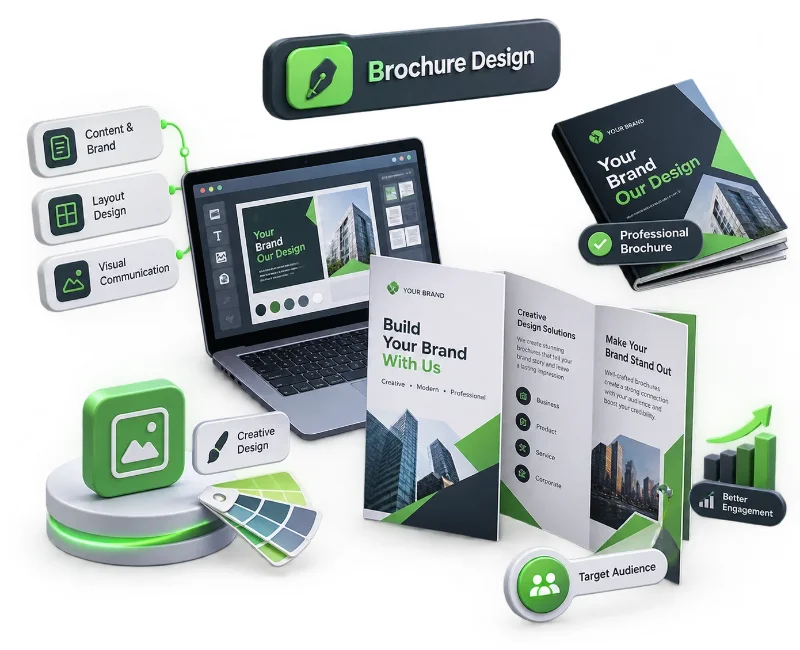
A brochure should do more than place text and images on a few pages. It should help a prospective customer understand what your business offers, why it matters, and what to do next.
FalconicsIT provides brochure design services for businesses that need a polished, structured, and brand-consistent way to present their company, products, services, projects, or offerings. From corporate brochures and company profiles to product-focused brochures and digital PDFs, each design is planned around the information your audience actually needs.
Whether the brochure will be printed for meetings, shared with prospects, presented by a sales team, or distributed digitally, the objective remains the same: make important information easier to understand and easier to remember.
Value points
Clear information hierarchy that makes important content easy to scan
Visual design aligned with your existing brand identity
Layouts prepared for the intended print or digital format
Brochures structured around business and audience requirements
FalconicsIT approaches brochure design as a combination of visual communication, content structure, and brand presentation. The design is developed around the purpose of the brochure rather than applying the same layout to every business.
Depending on your requirements, the project can cover the structure, page layouts, typography, colour usage, imagery, graphics, icons, product presentation, company information, calls to action, and final artwork.
Common brochure formats include:
Corporate and company brochures
Product and service brochures
Business profiles
Marketing and sales brochures
Product catalogues
Bi-fold and tri-fold brochures
Multi-page brochures and booklets
Digital brochures and presentation-ready PDFs
A company brochure often serves as a compact introduction to the business. It may need to communicate your capabilities, services, experience, solutions, industries served, facilities, projects, or business approach without overwhelming the reader.
We structure the visual presentation so that company information has a logical flow and the most relevant messages receive appropriate attention. This can make the brochure useful for sales meetings, business enquiries, exhibitions, presentations, and client communication.
When the objective is to promote a product or service, the design needs to support the buying conversation.
Product specifications, features, applications, benefits, imagery, technical information, and enquiry details can be arranged into a format that allows prospects to find relevant information quickly.
For businesses with multiple offerings, the brochure can also create a consistent visual system across product categories while keeping individual sections easy to navigate.
Not every brochure is printed. Many businesses now share brochures through websites, email, WhatsApp, sales presentations, and other digital channels.
Digital brochure design considers screen readability, page composition, image quality, file usability, and the way customers are likely to view the document. Where required, the final artwork can be prepared as a professional PDF suitable for digital distribution.
Good design starts before the first page is designed. We first understand what the brochure needs to communicate, who will read it, and where it will be used.
01 — Understand the Requirement
We review your business, target audience, brochure purpose, preferred format, available content, brand guidelines, imagery, and any specific design references.
02 — Plan the Content Structure
The information is organised into a logical page flow. This helps prevent overcrowded layouts and ensures that important information is not buried beneath secondary content.
03 — Design the Visual Direction
Typography, colours, imagery, spacing, graphics, and page composition are developed to create a consistent visual language that fits your brand.
04 — Refine & Finalise
Feedback is incorporated during the review stage, followed by preparation of the final artwork in the agreed format.
The exact deliverables depend on the scope of the project, but a brochure design engagement can include:
Professionally designed brochure pages
Brand-aligned typography, colours, and visual elements
Structured presentation of supplied text and imagery
Product, service, or company information layouts
Print-ready artwork where required
Digital-ready PDF output where required
Final files in agreed formats
A brochure can give your sales and marketing teams a structured resource to use when explaining an offering.
Instead of relying entirely on verbal explanations or scattered documents, relevant company or product information can be brought together into one professionally designed asset.
A well-structured brochure can also support brand consistency. When typography, colours, imagery, messaging, and visual hierarchy work together, the document becomes an extension of the company's overall identity rather than a standalone promotional sheet.
Businesses often come to brochure design with content that is already available but difficult to present effectively.
Typical challenges include too much information on a page, inconsistent visual styles, outdated layouts, weak content hierarchy, poor-quality imagery, unclear product presentation, or a brochure that does not reflect the quality of the business itself.
The design process addresses these issues by organising information, creating a consistent visual system, and giving the reader a clearer path through the document.
Brochure design can be useful for businesses at different stages and across different sectors.
Startups and growing businesses can use brochures to introduce their company and offerings to prospective customers, partners, or investors.
B2B companies can use them to communicate capabilities, solutions, technical information, and company credentials during sales discussions.
Manufacturers and product businesses can present product ranges, specifications, applications, and key information in a structured format.
Professional service providers can use company brochures to explain their expertise, services, approach, and areas of specialisation.
D2C and consumer brands can use brochures and product catalogues to support promotions, retail communication, events, and product presentations.
Brochure pricing depends on the scope rather than simply the number of pages.
Factors can include the total page count, complexity of the layout, amount of content, image requirements, level of customisation, number of products or services being presented, design revisions, and whether additional content or creative work is required.
For a more accurate quotation, we can review the brochure requirements and provide a scope based on the actual project instead of applying an unsuitable standard package.
The quality and speed of a brochure project can improve when the required materials are available at the beginning.
Depending on the project, you may need to provide your logo, brand guidelines, written content, product information, photographs, product specifications, contact details, preferred references, and any mandatory information that needs to appear in the brochure.
If the content is incomplete or needs substantial rewriting, that requirement can be discussed separately before the project begins.
The timeline depends on the brochure's page count, content readiness, design complexity, feedback cycles, and required deliverables.
Projects with organised content and clearly defined requirements can generally move through design more efficiently. Larger catalogues, technical brochures, or projects requiring substantial content development naturally require more planning.
Design should not be rushed simply to meet an arbitrary deadline. The goal is to create a brochure that is accurate, coherent, visually consistent, and ready for its intended use.
FalconicsIT brings branding and creative work into a wider digital and technology environment. That broader perspective can be useful when a brochure needs to remain consistent with a company's website, digital campaigns, brand identity, or other customer-facing assets.
Our approach is focused on understanding the business requirement first, then translating that requirement into a practical visual solution. Rather than relying on a fixed template, the design is developed around the content, audience, brand, and intended application.
The result is a brochure designed to communicate clearly while fitting naturally into the rest of your marketing presence.
We can design corporate brochures, company profiles, product brochures, service brochures, marketing brochures, catalogues, booklets, bi-fold and tri-fold brochures, and digital brochures based on the project requirement.
Yes. Existing content can be structured and presented within the design. If the content needs substantial rewriting, expansion, or creation, the additional requirement can be discussed as part of the project scope.
Yes. Existing logos, colours, typography, brand guidelines, imagery, and other visual assets can be incorporated into the brochure design to maintain consistency with your brand.
Yes. The design can be planned according to whether the brochure will be printed, shared digitally, or used for both purposes. The final file requirements should be confirmed before production.
Yes. Product catalogues can be handled when the project requires multiple products, categories, specifications, images, or other structured product information.
There is no universal page count. The appropriate length depends on how much information needs to be communicated and how the brochure will be used. A shorter brochure may work for a focused offering, while a company profile or catalogue may require more pages.
Yes. You can provide your own product, team, facility, project, or other relevant images. Image requirements and any additional image sourcing can be discussed during project planning.
The timeline depends on the number of pages, content readiness, design complexity, feedback, and final output requirements. A project timeline can be confirmed after reviewing the scope.
Pricing depends on factors such as page count, design complexity, content requirements, imagery, revisions, and the type of final artwork required. A project-specific quotation can be provided after understanding these requirements.
Yes. Feedback and revisions can be incorporated according to the agreed project scope. The expected revision process should be confirmed before the project begins.
Share your brochure requirements, existing content, preferred format, brand assets, approximate page count, and intended use. The FalconicsIT team can then review the requirement and discuss the appropriate scope.
Your brochure should make it easier for customers to understand your business, not make them work through an overcrowded document.
Share your content, requirements, and preferred format with FalconicsIT. We can discuss the structure, design direction, deliverables, and scope needed for your brochure.
Contact our expert team today for a tailored strategy and free consultation.
Get a Free Consultation