
Ready to transform your business with App UI/UX?
Contact our expert team today for a tailored strategy and free consultation.
Get a Free ConsultationNo services available in this category yet.
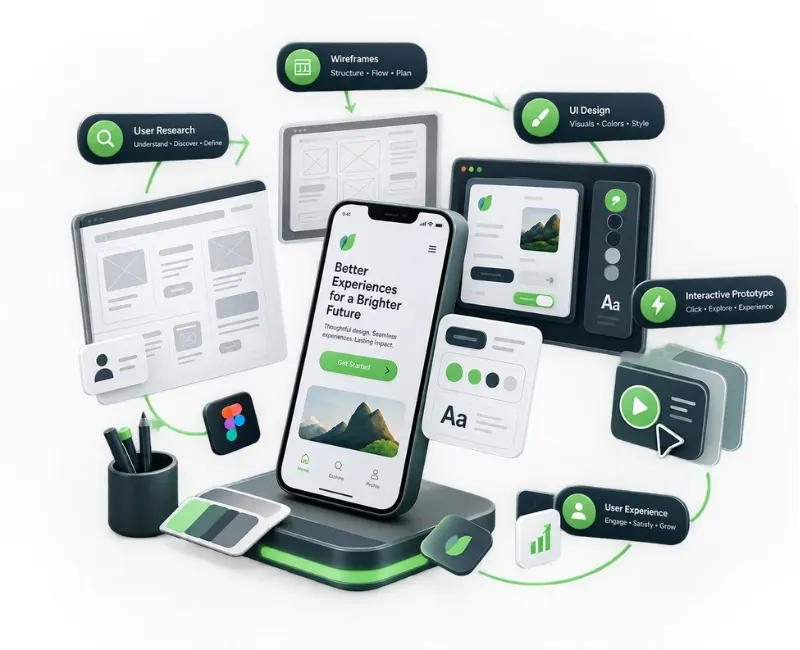
A good digital product should not make users think about how to use it. Falconics creates UI UX experiences that bring together clear navigation, purposeful interactions, visual consistency and business objectives.
From websites and mobile apps to SaaS platforms and custom digital products, our UI UX design process focuses on understanding the user journey before turning ideas into practical, high-fidelity interfaces.
UI and UX are closely connected, but they solve different parts of the digital experience.
UX design focuses on how a product works — its structure, navigation, workflows, usability and overall journey.
UI design focuses on how that experience looks and communicates — including layouts, typography, colour, components, visual hierarchy and interaction states.
Effective UI UX design brings both together. The result is not simply a visually attractive interface, but a product that helps users understand what to do, complete tasks with less friction and interact confidently with the brand.
Falconics approaches UI UX design as a product experience rather than a collection of individual screens. The exact scope can be adapted according to the project's goals, complexity and development requirements.
Before designing screens, we work to understand the product, its users, business objectives and existing experience.
Depending on the project, discovery can include stakeholder inputs, competitor review, user journeys, usability considerations and analysis of existing interfaces.
This provides a clearer foundation for deciding what the product should prioritise before visual design begins.
A well-designed interface starts with a logical structure.
We map important user journeys and organise content, functionality and navigation so users can move through the product without unnecessary complexity.
For larger websites, applications and SaaS products, this stage can be particularly valuable because a strong information architecture reduces confusion as the product grows.
Wireframes help establish the structure of a page or product before visual details take over.
We define layouts, content hierarchy, navigation and key interactions so that usability problems can be addressed earlier in the design process.
Interactive prototypes can then demonstrate important flows and provide a practical representation of how the final experience should behave.
Once the experience structure is established, we develop the visual interface.
This can include typography, colour systems, spacing, buttons, forms, cards, navigation elements, icons and other interface components.
For products that require ongoing development, reusable design components help maintain consistency and make future screens easier to design and implement.
Digital experiences need to work across the devices customers actually use.
Our UI UX design can account for responsive web experiences, mobile applications and different screen sizes, with layouts and interactions adapted accordingly.
The goal is to preserve usability and visual hierarchy rather than simply shrinking a desktop interface onto a smaller screen.
A design becomes more valuable when it can be implemented accurately.
Where required, we prepare high-fidelity screens, interactive prototypes, reusable components and design specifications that help developers understand intended layouts, interactions and states.
This creates a clearer bridge between design and development.
UI UX design influences much more than visual appearance. It affects how quickly users understand a product, how confidently they navigate it and how easily they complete important actions.
For businesses, thoughtful UX can help reduce friction across important journeys such as enquiries, registrations, purchases, bookings, onboarding or product usage.
A stronger experience can also make a complex product easier to communicate. This is especially useful for SaaS platforms, technology products, ecommerce businesses and service websites where users may need to understand several features before taking action.
Our process is structured enough to maintain direction while remaining flexible enough for different types of projects.
01 — Discover
We understand the business, product, target users, existing experience, project requirements and desired outcomes.
02 — Define
User journeys, information architecture and functional priorities are established so the design has a clear foundation.
03 — Design
Wireframes evolve into polished interfaces with attention to hierarchy, interaction, accessibility, consistency and responsive behaviour.
04 — Prototype & Refine
Important journeys can be prototyped to review interactions and identify areas that need improvement before development.
05 — Handoff & Support
Final design assets and specifications are prepared for implementation. Where required, we can continue supporting the product through development and future improvements.
The final deliverables depend on the project's scope, but may include:
Not every project requires every deliverable. We recommend the appropriate design depth based on the product rather than adding unnecessary stages.
UI UX requirements vary significantly depending on what is being designed.
For business websites, the focus may be on information hierarchy, trust, navigation and conversion journeys.
For mobile applications, usability, interaction patterns and task completion become especially important because of the smaller screen and touch-based environment.
For SaaS and software products, the challenge is often managing complexity without overwhelming users. Clear workflows, dashboards, permissions, forms and reusable components become central to the experience.
For ecommerce, product discovery, filtering, product information, checkout and post-purchase journeys can have a direct impact on the customer's experience.
Our UI UX design services can support businesses at different stages, including:
Many design projects begin with a visible problem but require deeper investigation to identify the underlying issue.
Users may struggle to find important information, abandon a form, misunderstand an interface, get lost within a workflow or simply fail to see the value of a product quickly enough.
A redesign should therefore do more than change colours, typography or page layouts. The objective is to identify where the experience creates unnecessary friction and redesign those areas with a clearer structure.
A redesign may be worth considering when your website or product looks outdated, users struggle with important workflows, the interface has become inconsistent, or new functionality has been added without a coherent design system.
It can also make sense before a major development project. Establishing the experience and interface direction before development can reduce ambiguity and help the technical team build against a clearer product specification.
Falconics approaches UI UX design with both design and technology in mind. Our broader digital capabilities allow design decisions to be considered alongside web development, mobile applications, software and other digital requirements.
This is particularly useful when design needs to connect directly with development. The objective is to create interfaces that are not only visually considered but practical to build, maintain and evolve.
We focus on understanding the business and its objectives before moving into execution, allowing the design direction to reflect the product's actual requirements rather than relying on a fixed design formula.
A digital product rarely remains static after launch.
New features, customer requirements, business priorities and technology changes can all affect the experience over time. A scalable design system and consistent component structure can make those future changes easier to manage.
For growing businesses, UI UX design can become part of the product foundation rather than a one-time visual exercise.
UI UX design pricing depends on the scope and complexity of the project rather than a fixed universal rate.
Factors can include the number of screens or workflows, whether research is required, product complexity, responsive requirements, prototype depth, design-system requirements and the level of collaboration needed with development teams.
After understanding the project, the scope can be defined around the actual design requirements instead of charging for unnecessary deliverables.
Good design requires collaboration.
The quality and speed of the project can be influenced by the availability of business requirements, existing brand guidelines, product information, stakeholder feedback and access to relevant analytics or user insights where available.
Design should also be evaluated against the right objective. A visually impressive interface is not automatically a successful user experience; usability, clarity and suitability for the intended audience matter just as much.
Depending on the project, UI UX design can include UX research, information architecture, user flows, wireframes, interface design, prototypes, responsive layouts, design systems and developer handoff.
Yes. UI UX design can be developed for websites, mobile applications, SaaS products and other digital interfaces, with the design approach adapted to the platform and user journey.
UX focuses on the structure and usability of the experience — how users navigate and complete tasks. UI focuses more on the visual interface, including layouts, typography, colours, components and interaction states. Effective product design considers both together.
Yes. A redesign can address usability issues, outdated interfaces, inconsistent components, confusing navigation and other experience problems while preserving elements that are already working well.
Research and discovery can be included when the project requires it. The appropriate research depth depends on the product, available information, audience and project objectives.
Interactive prototypes can be included where they provide value, particularly for important workflows, product validation, stakeholder reviews or development planning.
Yes, where the product benefits from a reusable component structure. A design system can help maintain consistency and make future interface development more efficient.
Yes. Design can be prepared for development handoff, and Falconics also has web, mobile and software development capabilities, which can support projects requiring closer design-to-development coordination.
There is no single timeline for every project. Duration depends on the number of screens, product complexity, research requirements, feedback cycles, prototype requirements and overall scope.
Pricing is based on factors such as project scope, complexity, number of workflows or screens, research requirements, design-system needs, prototyping and ongoing support. A suitable scope can be defined after understanding your requirements.
Start by sharing your product or website requirements, current challenges, target users and what you want to improve. The next step is to discuss the scope and determine the appropriate design approach.
Whether you are launching a new product, redesigning an existing interface or improving a complex application, the right design process can make the experience clearer for both users and your development team.
Contact our expert team today for a tailored strategy and free consultation.
Get a Free Consultation