
Ready to transform your business with App Store Optimization?
Contact our expert team today for a tailored strategy and free consultation.
Get a Free ConsultationNo services available in this category yet.
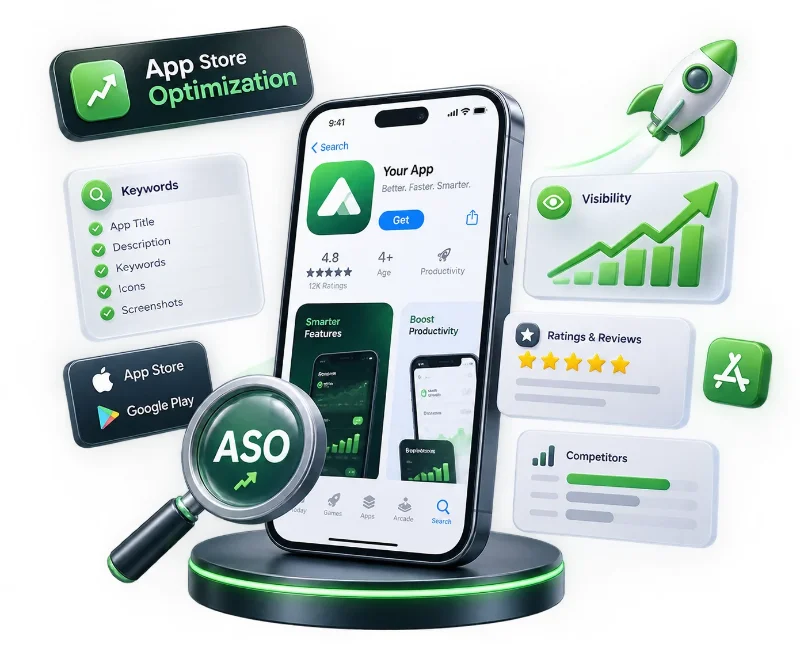
A well-built mobile app still needs to be discovered before it can acquire users. App Store Optimization (ASO) improves the way your app appears, communicates its value, and converts store visitors across platforms such as Google Play and the Apple App Store.
Falconics IT approaches ASO as an ongoing optimization process rather than a one-time keyword exercise. We examine your app, market, competitors, target users, and existing store performance to identify opportunities across search visibility and conversion.
Whether you are launching a new application or trying to improve an established app's store performance, the objective is to make the listing more relevant to the searches and expectations of your potential users.
What we focus on:
Relevant search terms and app-store keywords
Clear, persuasive store listing content
Stronger conversion from listing views to installs
Competitive positioning within your app category
ASO combines search relevance with conversion optimization. The work extends beyond adding keywords to an app title or description.
A strong ASO strategy considers how users search, how app stores interpret listing information, what competitors are targeting, and what persuades someone to install an app after reaching its listing.
Depending on the app and marketplace, optimization may cover metadata, keyword targeting, descriptions, screenshots, icons, preview assets, ratings and reviews, localization, and performance monitoring.
The exact priorities depend on your current listing, category, audience, competition, and business objectives.
The first step is understanding where your app currently stands.
An ASO audit reviews important elements of your store presence, including metadata, keyword targeting, listing structure, visual assets, category positioning, and areas that may be limiting discoverability or conversions.
The audit creates a practical starting point for deciding what should be changed first rather than making isolated listing edits without context.
Keyword selection determines how closely your app listing aligns with the searches made by prospective users.
We research relevant search terms around your app's functionality, category, audience, and competitive environment. Keywords are assessed for relevance and commercial usefulness rather than selected simply because they have high search interest.
The resulting keyword strategy can guide metadata, content updates, and future optimization decisions.
Your app title, subtitle, short description, long description, and other available metadata contribute to how your listing communicates relevance.
Falconics IT refines these elements around the selected keyword strategy while keeping the copy natural and useful to actual users. The aim is to balance discoverability with a clear explanation of what the app does and why someone should consider installing it.
Metadata requirements and available fields differ between Google Play and the Apple App Store, so optimization is adapted to the relevant platform.
Getting users to your listing is only one part of the process. The listing also needs to give them enough information and confidence to take the next step.
We review the presentation of your app through elements such as screenshots, icons, descriptions, feature messaging, and other available visual assets. Where appropriate, recommendations focus on clearer messaging, stronger presentation, and reducing uncertainty around the app's value.
The goal is to make the store experience better aligned with the expectations created by search queries and acquisition campaigns.
Your app competes for attention within a specific category, not in isolation.
Competitor analysis helps identify recurring keyword themes, positioning approaches, feature communication, visual patterns, and opportunities for differentiation. This information can be used to shape a more relevant store listing without simply copying what competing apps are doing.
Ratings and reviews can influence how potential users perceive an app before installation. They can also reveal recurring concerns that may need attention beyond the store listing itself.
ASO work can include reviewing available user feedback and identifying themes that affect trust, expectations, and conversion. The objective is not to manufacture positive sentiment, but to use genuine user feedback as an input for better communication and optimization.
An app targeting multiple regions may need more than a direct translation of its existing listing.
Where localization is part of the engagement, keyword research, metadata, messaging, and visual communication can be adapted to the relevant language and market context. This helps ensure the store listing reflects how prospective users actually search and evaluate apps in that market.
Effective ASO can support several parts of the app acquisition journey.
Greater discoverability: Better alignment between your listing and relevant searches can make it easier for prospective users to find the app.
More qualified store traffic: Targeting terms that accurately represent your app helps attract users with a clearer interest in what you offer.
Stronger listing conversion: Better messaging and visual presentation can help turn store visitors into potential installers.
Reduced dependence on paid acquisition: Organic app-store visibility can complement paid campaigns and provide another route to user acquisition.
Better market positioning: Competitor and category analysis provides a clearer view of how your app is presented within its marketplace.
Ongoing optimization opportunities: Performance data and user feedback create inputs for future listing improvements rather than treating ASO as a one-time project.
The process is adapted to the app, platform, category, and current level of optimization.
1. Discovery and App Review
We begin by understanding your app, business objective, target audience, current store presence, and key acquisition challenges.
2. ASO Audit and Competitive Research
Existing metadata, visual assets, category positioning, and competitor listings are reviewed to identify opportunities and priorities.
3. Keyword Research and Strategy
Relevant search terms are researched and mapped according to the app's functionality, audience, competition, and marketplace.
4. Listing Optimization
Priority metadata and store-facing content are refined, with recommendations for visual elements where they contribute to listing conversion.
5. Implementation and Review
Approved changes are implemented according to the applicable app-store requirements and reviewed for consistency and relevance.
6. Monitoring and Iteration
Performance indicators are monitored to identify opportunities for further refinement. ASO is treated as an ongoing process because search behavior, competition, app features, and marketplace conditions can change.
The specific deliverables depend on the scope of your ASO project, but an engagement can include:
ASO audit and opportunity assessment
App-store keyword research
Competitor and category analysis
Title, subtitle, short-description and long-description recommendations
Store listing content optimization
Screenshot and visual asset recommendations
Localization recommendations where applicable
Performance monitoring and optimization recommendations
Implementation requirements can vary depending on whether your team, development partner, or ASO provider manages changes inside the relevant developer accounts.
ASO can be useful for businesses at different stages of an app's lifecycle.
New app launches can use ASO to establish a relevant store presence from the beginning instead of waiting for discoverability problems to appear.
Established apps can use optimization to identify underperforming listing elements, expand relevant keyword coverage, and refine their store positioning.
E-commerce and D2C businesses can use ASO to make shopping applications easier for prospective customers to discover.
SaaS and technology businesses can use store optimization to communicate product functionality clearly to users searching for mobile solutions.
Consumer and service applications can benefit when store visibility and listing conversion are important parts of their acquisition journey.
Many apps have strong functionality but underperform in the app marketplace because their store presence does not clearly communicate that value.
Typical issues include:
Generic or poorly targeted metadata
Limited keyword coverage
Store copy that does not match user search intent
Weak screenshots or unclear feature communication
Low visibility for relevant search terms
A listing that attracts views but struggles to convert them
Limited understanding of competitor positioning
No structured process for ongoing ASO improvement
The solution is not always to change everything at once. A focused audit helps determine which elements deserve attention first.
ASO does not operate on a fixed timetable. The pace and extent of change can depend on your app's category, existing authority and visibility, competition, keyword difficulty, listing quality, update frequency, user behavior, and marketplace conditions.
Meaningful optimization requires testing, monitoring, and iteration rather than assuming that one metadata update will permanently determine an app's position.
Organic installs, rankings, and conversion performance should therefore be treated as outcomes influenced by multiple factors. ASO can improve the conditions for discovery and conversion, but no responsible provider should guarantee a specific ranking, number of installs, or revenue outcome.
ASO pricing depends on the scope and complexity of the engagement rather than a universal fixed rate.
Factors can include the number of platforms and apps involved, depth of keyword and competitor research, number of store listings, localization requirements, visual asset requirements, frequency of optimization, reporting needs, and ongoing support.
After understanding your app and objectives, the appropriate scope can be defined before work begins.
A useful ASO engagement should connect store optimization with the actual product and acquisition objective.
Falconics IT focuses on practical optimization: understanding the app first, identifying relevant search opportunities, improving how the product is presented, and using performance information to guide subsequent decisions.
Rather than treating ASO as keyword insertion alone, the approach considers the complete store journey—from search visibility to the information a potential user sees before deciding whether to install.
This also allows ASO recommendations to remain aligned with the app's actual features and target audience instead of making claims that the product experience cannot support.
App Store Optimization is the process of improving a mobile app's visibility and conversion within app marketplaces. It can involve keyword research, metadata optimization, visual assets, competitor analysis, localization, ratings and reviews, and ongoing performance analysis.
An app needs to be discoverable and clearly presented before users can decide to install it. ASO helps align the app's store presence with relevant searches while improving the information and presentation users see when evaluating the listing.
They share principles such as keyword research, relevance, optimization, and performance monitoring, but they focus on different environments. SEO primarily concerns search engines and websites, while ASO focuses on app marketplaces and their specific ranking and conversion factors.
ASO can be tailored to the relevant app marketplaces. Google Play and the Apple App Store have different listing structures and optimization considerations, so the strategy should be adapted rather than duplicated unchanged across platforms.
ASO is intended to improve discoverability and the ability of a store listing to convert relevant visitors into installs. Actual download performance depends on factors such as search demand, competition, product quality, reviews, listing presentation, and user behavior, so specific download numbers should not be guaranteed.
There is no universal timeline for ASO results. The timeframe can vary based on the app's existing visibility, category competition, keyword targets, marketplace, update frequency, and other performance factors. Ongoing monitoring is generally more useful than judging the strategy from a single update.
Not necessarily. Much of ASO concerns the store listing and its presentation. However, app quality, user experience, ratings, reviews, retention, and other product-related factors can influence how effectively store optimization translates into sustainable acquisition.
Yes. Existing apps can be audited to identify opportunities in metadata, keywords, visual presentation, competitive positioning, and conversion. The optimization priorities can then be based on the app's current situation rather than starting from a generic template.
Localization can be incorporated when an app targets multiple regions or languages. The work should account for local search behavior and messaging rather than relying solely on direct translation.
Typically, the process starts with information about the app, its target audience, business objectives, current store listings, competitors, and existing performance information. Access and implementation requirements can be discussed based on the agreed scope.
Yes. Ongoing ASO can involve monitoring performance, researching new keyword opportunities, reviewing competitors, evaluating user feedback, and making further listing recommendations as the app and marketplace evolve.
Your app listing should do more than exist in the marketplace. It should clearly communicate what your product offers and make it easier for relevant users to discover and evaluate it.
Falconics IT can assess your current app-store presence, identify practical optimization opportunities, and develop an ASO scope around your business objectives.
Contact our expert team today for a tailored strategy and free consultation.
Get a Free Consultation