
Ready to transform your business with App Maintenance?
Contact our expert team today for a tailored strategy and free consultation.
Get a Free ConsultationNo services available in this category yet.
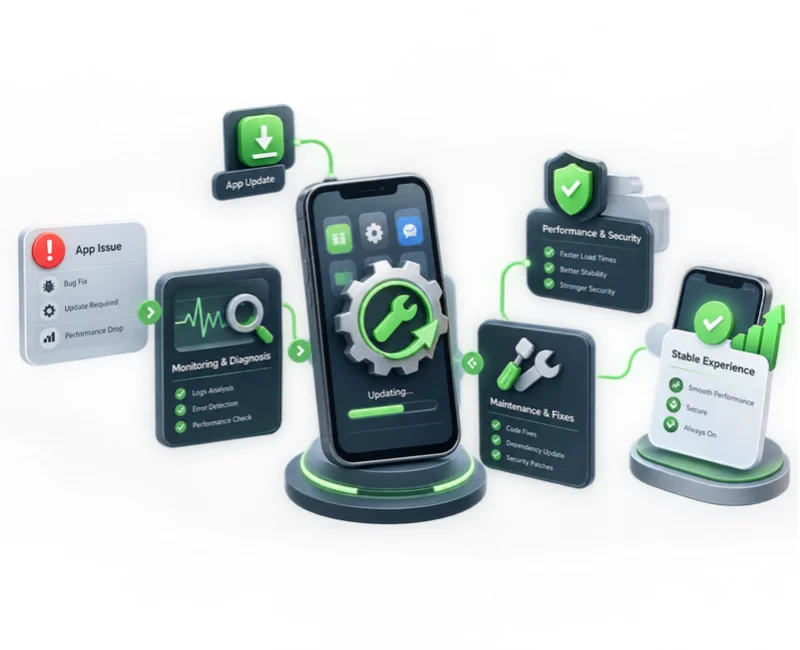
A mobile app needs attention long after its initial launch. New operating system versions, device changes, third-party APIs, security requirements, backend dependencies, and user expectations can all affect how an application performs.
Falconics IT provides app maintenance services for businesses that need dependable technical support without rebuilding their application from scratch. We help maintain existing Android, iOS, and cross-platform applications through structured troubleshooting, updates, optimization, and ongoing improvements.
Key areas of support include:
App maintenance is the ongoing technical work required to keep an application functional, secure, compatible, and useful after launch.
It is more than fixing bugs when something breaks. Effective maintenance also involves identifying recurring issues, keeping dependencies current, adapting the app to platform changes, monitoring performance, and making controlled improvements as business requirements evolve.
The right maintenance approach depends on the application's architecture, technology stack, integrations, user base, release cycle, and business criticality.
Production issues can affect individual features or disrupt important user journeys such as registration, login, payments, search, checkout, bookings, or notifications.
Falconics IT can investigate application errors, crashes, broken functionality, API failures, UI issues, and other technical problems. The focus is not only on restoring the affected feature but also on understanding the underlying cause so recurring problems can be addressed systematically.
Slow screens, excessive resource usage, failed API requests, inefficient code, and backend bottlenecks can gradually affect an application's usability.
Maintenance work can include performance analysis, code-level improvements, API optimization, database-related troubleshooting, and investigation of crashes or stability issues. The objective is to make the existing application more dependable without introducing unnecessary changes.
Mobile platforms continue to change. Operating system updates, device specifications, permissions, libraries, SDK requirements, and platform policies can create compatibility issues for an existing application.
Regular maintenance helps identify and address these changes before they become larger production problems. Depending on the application, support may cover Android, iOS, or cross-platform environments such as Flutter and React Native.
Outdated libraries, frameworks, SDKs, plugins, and third-party components can create technical and security risks.
App maintenance can include reviewing dependencies, applying appropriate updates, addressing known vulnerabilities, and checking whether upgrades affect existing functionality. Security work is performed with attention to application architecture and compatibility rather than applying updates blindly.
A mobile application often depends on more than its mobile code. APIs, authentication systems, payment gateways, cloud services, databases, analytics platforms, notification services, and other integrations can all influence application performance.
When an integration changes or fails, the mobile application may need corresponding updates. Falconics IT can support the application layer and related technical dependencies within the agreed project scope.
Maintenance can also be an opportunity to improve an existing product.
When a business needs a new feature, workflow adjustment, interface improvement, or integration, the work can be planned around the current application architecture. This helps avoid treating every change as a complete redevelopment project while keeping existing functionality in consideration.
The value of ongoing maintenance is not simply having someone available when an issue occurs. A well-managed maintenance engagement gives the application a clearer technical direction and reduces the risk of unmanaged changes accumulating over time.
Depending on your requirements, maintenance can help with:
Every application starts from a different technical position, so maintenance should begin with understanding rather than assumptions.
01 — Application Assessment
We review the application's current condition, technology stack, architecture, integrations, known issues, deployment setup, and maintenance requirements.
02 — Prioritization
Issues are assessed according to technical impact and business importance. Critical production problems and user-facing failures take priority over lower-impact improvements.
03 — Fix & Improve
The required fixes, updates, optimizations, or enhancements are implemented with attention to existing functionality and dependencies.
04 — Test & Validate
Changes are tested against relevant application flows and supported environments before release. Where appropriate, regression checks help reduce the risk of one fix affecting another feature.
05 — Maintain & Optimize
Ongoing requirements are handled through a structured maintenance cycle, allowing the application to adapt as operating systems, dependencies, integrations, and business requirements change.
The exact scope is defined according to your application and engagement model. Typical deliverables may include:
| Area | Typical Deliverables |
|---|---|
| Bug Fixing | Investigation and resolution of application errors, crashes, and functional issues |
| Performance | Performance analysis, optimization, and stability improvements |
| Compatibility | Updates required for supported Android, iOS, devices, SDKs, and libraries |
| Security | Dependency updates, vulnerability-related fixes, and security-focused maintenance |
| Integrations | API, backend, payment, notification, analytics, and third-party integration support |
| Enhancements | Selected feature updates, UI improvements, and workflow changes |
| Technical Support | Troubleshooting, issue analysis, release assistance, and maintenance guidance |
The final deliverables depend on the application's technology, condition, and agreed scope.
App maintenance is particularly useful when an existing application is experiencing issues such as:
Startups and growing businesses can use ongoing maintenance to keep an existing product reliable while their internal team focuses on product and business development.
Established businesses may need a dedicated technical partner for applications that support customers, employees, sales, operations, or internal workflows.
E-commerce and digital businesses often require continued attention to payments, APIs, performance, notifications, and customer-facing journeys.
Businesses with legacy applications can use maintenance support to stabilize an older application, address technical debt, and plan improvements before considering a larger modernization project.
Companies with an internal development team can also use external maintenance support when additional technical capacity is needed for specific platforms, releases, integrations, or backlog items.
Falconics IT works across modern web and technology environments, with capabilities spanning mobile application development and supporting technologies. Depending on the existing application, maintenance requirements may involve technologies such as Flutter, React Native, JavaScript, Node.js, Java, Python, AWS, databases, APIs, and related development infrastructure.
The appropriate technology approach is determined by the application's existing stack rather than forcing a new framework simply for the sake of modernization.
Falconics IT approaches application maintenance as an ongoing technology responsibility rather than a collection of isolated bug fixes.
The wider technology capabilities of the team allow mobile applications to be considered alongside APIs, software systems, cloud infrastructure, automation, analytics, and other connected components when those dependencies affect the application.
The engagement can also be structured around the actual needs of the application. Some businesses need help with a defined technical backlog, while others require continuing support for releases, compatibility, troubleshooting, and improvements.
Most importantly, the maintenance scope is discussed before work begins so expectations around responsibilities, priorities, technologies, and deliverables remain clear.
App maintenance does not have to follow one fixed model.
A business with occasional technical requirements may prefer on-demand or project-based support for specific fixes, upgrades, or enhancements.
Applications that require regular attention may benefit from an ongoing maintenance arrangement covering agreed support and development requirements.
For business-critical applications, a broader long-term support model can provide continuity for maintenance, updates, optimization, and planned improvements.
The appropriate model depends on application complexity, issue frequency, internal resources, technology stack, and the level of support required.
Maintenance timelines vary considerably because a minor compatibility fix and a complex production issue are fundamentally different pieces of work.
Before implementation, the application and reported requirements are reviewed to understand dependencies, technical complexity, testing requirements, and release considerations. This makes it possible to establish a more realistic delivery expectation rather than promising a fixed timeline without reviewing the application.
For ongoing support, priorities can change as new operating system versions, security issues, third-party changes, or business requirements emerge.
App maintenance pricing is determined by the actual scope rather than a fixed universal rate.
Factors can include the application's size and complexity, technology stack, number of platforms, backend architecture, third-party integrations, frequency of updates, existing technical debt, required support level, testing requirements, and whether new features are included.
Falconics IT can assess your application and requirements before defining the appropriate engagement and scope.
App maintenance is the ongoing technical support required to keep a mobile application functional, secure, compatible, and up to date. It can include bug fixing, performance optimization, platform updates, dependency management, integration support, and feature improvements.
Mobile applications depend on operating systems, devices, APIs, libraries, backend services, and third-party platforms that change over time. Without maintenance, an application can develop compatibility, security, performance, or functionality problems.
Yes, an existing application can be assessed for maintenance even if it was originally developed by another team. Access to the relevant source code, development environment, documentation, hosting, accounts, and technical dependencies may be required before work can begin.
Yes. The maintenance scope can cover Android, iOS, or cross-platform applications depending on the application's technology and requirements.
Yes. Feature enhancements can be included when they fit the agreed scope. Larger product changes may be treated as separate development work depending on their complexity.
Yes. Bug investigation and production issue resolution are common parts of app maintenance. The approach depends on the nature of the issue, its impact, and the underlying cause.
An outdated application can often be upgraded, but the required effort depends on its architecture, dependencies, code quality, platform requirements, and technical debt. An initial assessment helps determine whether incremental updates or broader modernization would be more appropriate.
There is no single maintenance schedule for every application. Business-critical apps may require regular monitoring and updates, while smaller applications may need support when platform, security, or business changes occur. The right frequency depends on the application's environment and usage.
Typically, the development team will need relevant source code, access to required repositories and environments, application credentials where applicable, existing documentation, known issue details, and information about the current production setup.
Pricing depends on factors such as application complexity, technology, number of platforms, integrations, support requirements, expected workload, testing needs, and whether ongoing enhancements are included. A specific scope can be discussed after reviewing the application.
Yes. Ongoing application maintenance and technical support can be structured around the application's needs, including troubleshooting, updates, performance work, compatibility changes, and planned improvements.
Your application should not have to wait for a major failure before receiving technical attention.
Whether you need help resolving existing issues, supporting a live application, preparing for platform changes, or improving an aging app, Falconics IT can assess the current situation and define a practical maintenance plan around your requirements.
Contact our expert team today for a tailored strategy and free consultation.
Get a Free Consultation