
Ready to transform your business with API Integration?
Contact our expert team today for a tailored strategy and free consultation.
Get a Free ConsultationNo services available in this category yet.
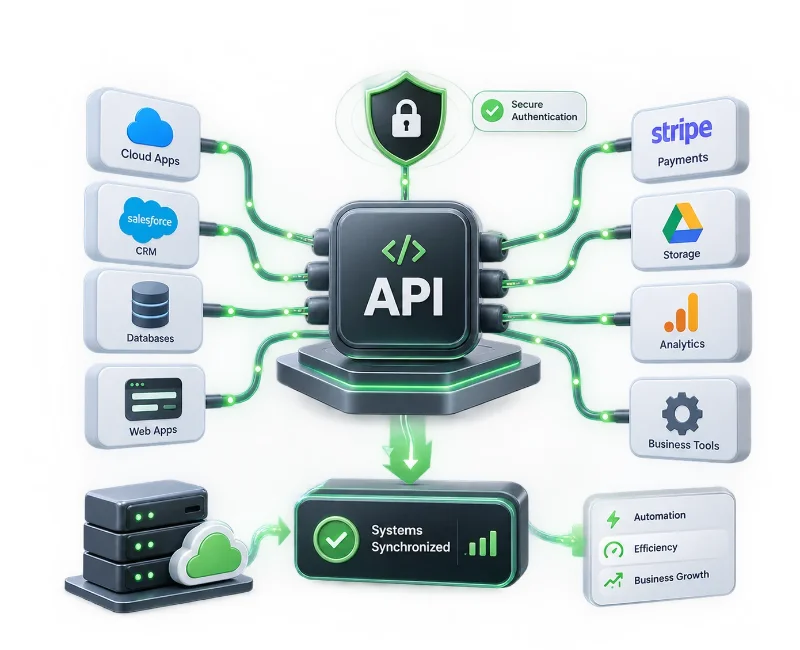
Build connected digital systems that exchange data reliably, automate workflows and work together as one technology ecosystem.
Falconics IT Solutions provides custom API development and integration services for businesses that need their websites, mobile apps, software platforms, databases and external services to communicate efficiently. Whether you need a new API, a third-party integration or a more dependable connection between existing systems, we design the solution around your technical architecture and business requirements.
What we can help with:
APIs act as the connection layer between different applications and services. They allow one system to request or send information to another without requiring the systems themselves to be rebuilt.
For example, an ecommerce application may need to communicate with a payment gateway, inventory system, shipping provider and CRM. Instead of handling each process manually, APIs can connect these systems so information moves between them as part of the same workflow.
Falconics approaches API integration as a business and technical problem—not simply as connecting two endpoints. The goal is to create integrations that fit your existing architecture, handle data consistently and remain manageable as your systems evolve.
When an existing API cannot provide the functionality your application needs, a custom API can create the required connection between your software, data and users.
We can design APIs around your application's requirements, including endpoint structure, request and response formats, authentication, data handling and integration logic. The implementation can be planned around the technology stack and infrastructure already used by your business.
Custom APIs can supportMany businesses do not need to build every technology component themselves. Integrating established web applications, mobile applications, SaaS platforms, internal business systems and other software products that need controlled access to data or functionality.
Many businesses do not need to build every technology component themselves. Integrating established third-party services can add functionality while keeping the core application focused on its primary purpose.
API integration can connect your application with services such as:
The integration is planned around the way your systems actually exchange information, including authentication, data mapping, error handling and the behaviour of external services.
REST APIs remain a practical choice for connecting web applications, mobile applications and backend systems.
Falconics can help design or integrate REST-based interfaces where they make sense for the application's architecture. The implementation can account for endpoint structure, HTTP methods, authentication, response formats, validation and error handling.
The focus is not simply on making an API call work once. A useful integration should remain understandable, maintainable and predictable as the application develops.
API integration becomes particularly valuable when important business information is spread across multiple systems.
A website may hold customer information, an ERP may manage orders, a CRM may track sales activity and another platform may handle payments or communication. Without reliable connections, teams may have to duplicate information or move data manually.
A properly designed integration can establish controlled data flows between these systems, reducing unnecessary manual steps and creating a more connected operating environment.
An integration that works under normal conditions can still create problems when requests fail, credentials expire, data changes or an external service becomes unavailable.
API development therefore needs attention beyond basic functionality. Depending on the project, the implementation can include endpoint testing, validation, authentication checks, error handling and integration testing.
Security considerations can include access control, authentication, secure data transmission and appropriate handling of sensitive information. The exact controls depend on the systems being connected and the nature of the data involved.
APIs are rarely completely finished once they are deployed. Applications change, third-party providers update their interfaces and business processes evolve.
Ongoing API support can include troubleshooting integration issues, updating connections, improving performance, modifying endpoints, handling API version changes and maintaining compatibility with connected systems.
For businesses with critical integrations, continued technical oversight can also help identify problems before they disrupt important workflows.
API development and integration can be useful when your business is facing issues such as:
The right solution depends on the underlying architecture. In some cases, that means developing a new API. In others, improving an existing integration or replacing a fragile connection may be the better approach.
1. Understand the systems and requirements
We begin by identifying the applications involved, the data that needs to move, the required workflows and the business objective behind the integration.
2. Plan the integration architecture
The technical approach is defined around the existing environment. This includes determining integration points, data flows, authentication requirements, dependencies and the appropriate API structure.
3. Develop or integrate
Custom APIs are developed where required, while third-party APIs and existing systems are connected according to the agreed architecture.
4. Test the integration
The integration is evaluated for expected responses, data handling, error conditions and compatibility between connected systems. Testing depth depends on the complexity and risk of the project.
5. Deploy and support
Once the integration is ready, it is deployed into the appropriate environment. Post-launch support can address changes, troubleshooting, maintenance and future integration requirements.
The exact deliverables depend on your project, but an API engagement may include:
The scope is established before development so the project reflects the systems, functionality and integrations your business actually needs.
Falconics brings software development, web development, mobile development, AI, cloud and IT capabilities together, allowing API requirements to be considered within the wider technology environment rather than in isolation.
Our approach starts with understanding the business workflow and technical setup before deciding how the integration should be built. This helps avoid unnecessary complexity and keeps the solution aligned with the application it needs to support.
Where a project involves multiple technology areas, having related capabilities within one technology partner can also simplify communication between development, infrastructure and integration requirements.
API integration can support a wide range of businesses and technology environments.
Startups and growing businesses can connect essential services without building every supporting system from scratch.
Ecommerce businesses can integrate payments, inventory, shipping, customer systems and other operational platforms.
B2B companies can connect internal applications with customer, partner or enterprise systems.
SaaS and software companies can expose or consume APIs to connect products with other applications and services.
Established businesses can connect legacy applications with newer platforms and reduce dependence on manual data movement.
API development and integration pricing depends on the actual technical scope, so there is no sensible one-size-fits-all price.
Factors can include the number of systems involved, API complexity, number of endpoints, third-party dependencies, authentication requirements, data transformation, testing requirements, existing code quality and ongoing support needs.
After reviewing the requirements and existing environment, Falconics can define a project scope and recommend an appropriate engagement model.
API integration connects two or more applications, services or systems so they can exchange information or functionality programmatically. It can be used to automate workflows, synchronize data and extend the capabilities of an application.
API development involves creating an API that exposes data or functionality for other systems to use. API integration involves connecting an application to an existing API or connecting multiple systems so they can communicate.
A project may require one or both.
Yes. Third-party API integration can be added to an existing website, web application, mobile application or software platform, provided the current architecture and the third-party API support the required functionality.
The appropriate API technology depends on the project. REST APIs are commonly used for web and application integrations, while other approaches may be appropriate for specific architectures or real-time requirements.
Yes. API integration can connect different business systems when those platforms provide suitable integration capabilities. The implementation depends on the APIs, data structures and workflows involved.
Security depends on how the integration is designed and implemented. Authentication, authorization, secure data transmission, access controls, validation and appropriate error handling should be considered based on the systems and data involved.
The timeline depends on the number and complexity of integrations, existing application architecture, documentation quality, third-party dependencies and testing requirements. A straightforward integration can be considerably different from a multi-system enterprise integration.
Yes. Existing integrations can be reviewed when they are unreliable, difficult to maintain, slow or no longer fit the application's requirements. The appropriate solution may involve troubleshooting, restructuring, optimization or redevelopment.
Ongoing technical support can be provided based on project requirements. This may include troubleshooting, updates, integration changes, maintenance and performance-related improvements.
Start by sharing the systems you want to connect, the workflow you want to automate or the functionality you need. Falconics can then review the requirements and determine the appropriate development or integration approach.
Whether you need to connect two existing platforms, add third-party functionality to an application or develop a custom API from the ground up, Falconics can help plan and implement the integration around your technical requirements.
Contact our expert team today for a tailored strategy and free consultation.
Get a Free Consultation