
Ready to transform your business with AI Customer Support?
Contact our expert team today for a tailored strategy and free consultation.
Get a Free ConsultationNo services available in this category yet.
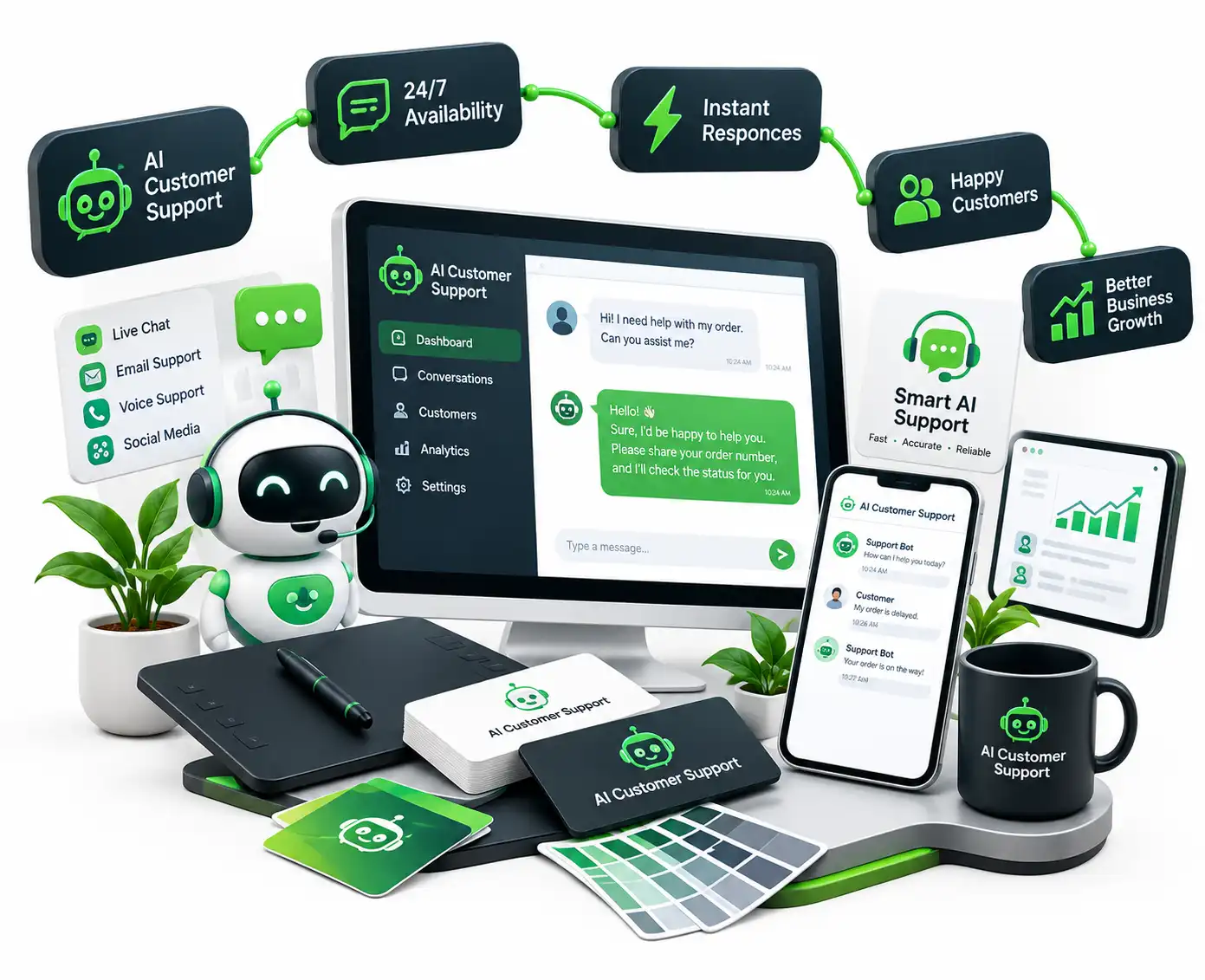
Customer support should not require your team to answer the same questions repeatedly. Falconics builds AI Customer Support solutions that use your business information, workflows, and support requirements to handle routine conversations while keeping human agents involved when judgment or personal attention is needed.
The goal is not to replace your support team. It is to give them an intelligent first layer of support that can respond quickly, collect relevant information, guide customers to the right solution, and hand over more complicated cases with the right context.
Key advantages
AI Customer Support combines artificial intelligence, conversational interfaces, business knowledge, and support workflows to help manage customer interactions.
Instead of relying entirely on predefined chatbot responses, an AI support system can interpret customer questions, identify intent, retrieve relevant information, and formulate an appropriate response. Depending on the workflow, it can also collect customer details, recommend next steps, create or route support requests, and escalate conversations to a human representative.
For businesses, this creates a more efficient support model: automation handles predictable interactions while people focus their time on cases that require expertise, empathy, negotiation, or decision-making.
The right support automation depends on your business, customer journey, and existing technology. Falconics can design the system around the conversations your customers actually have rather than forcing your business into a generic chatbot workflow.
Common use cases include:
The system can be structured so that customers receive an automated response when the AI has sufficient information and are transferred to a human representative when the situation requires further attention.
A useful customer support AI needs more than a general-purpose language model. It needs access to the information that makes your business different.
Depending on the project, the knowledge layer can be built around approved website content, FAQs, product information, service documentation, policies, internal resources, structured business data, and other relevant sources.
This allows responses to be aligned with your actual offerings and support policies rather than relying solely on generic answers.
Knowledge can also be reviewed and updated as products, services, processes, or policies change. That makes the support system easier to maintain as the business evolves.
Good automation knows when not to automate.
Some conversations require a human agent because they involve complaints, sensitive information, unusual requests, complex technical issues, billing concerns, negotiations, or situations where the available information is insufficient.
Falconics can build escalation rules that determine when a conversation should move from AI to a human. The objective is to make the transition clear and useful, with relevant conversation context available to the support team instead of forcing the customer to start over.
Customers may contact a business through different channels depending on the situation. A support strategy therefore needs to consider where conversations already happen rather than treating the website chatbot as the entire customer-service experience.
Depending on your requirements and technology stack, AI Customer Support can be connected with channels such as:
The exact channel mix and integrations are determined during the project based on your existing systems and customer journey.
AI can also improve the work happening behind the scenes.
A support assistant can help agents summarize conversations, suggest responses, retrieve relevant information, categorize enquiries, and reduce repetitive administrative work. This can be particularly useful when support teams manage high conversation volumes or work across multiple systems.
The result is a support workflow where AI assists both sides of the interaction: customers receive faster initial assistance, while human agents spend more time on cases where their expertise adds real value.
Faster first responses
Customers can receive immediate assistance for supported queries instead of waiting for an available representative.
Lower repetitive workload
Routine questions can be handled automatically, allowing support staff to concentrate on more valuable or complicated interactions.
More consistent answers
Approved business information and defined workflows help create greater consistency across common support conversations.
Better support scalability
Automation can provide an additional support layer as conversation volume grows without requiring every interaction to be handled manually.
Improved lead handling
AI can answer initial questions, collect qualifying information, and route promising enquiries to the appropriate team.
More organized customer conversations
Integrations and structured workflows can help businesses capture information and route requests more effectively.
Useful support insights
Conversation data can reveal recurring questions, friction points, missing information, and areas where the customer experience could be improved.
A successful AI support system starts with the support process, not the technology.
01 — Understand the business and support journey
We identify your customer types, common enquiries, support channels, existing tools, escalation requirements, and the tasks currently consuming your team's time.
02 — Define the knowledge and workflow
The next step is deciding what the AI should know, what it should be allowed to do, which questions it should answer, and which situations should go directly to a human.
03 — Build and integrate
Falconics develops the conversational experience and connects it with the relevant website, applications, communication channels, databases, CRM systems, or other business tools where required.
04 — Test real conversation scenarios
The system is tested against realistic customer questions, edge cases, unclear requests, escalation scenarios, and situations where the AI should avoid making assumptions.
05 — Deploy, monitor, and improve
After launch, conversations and support performance can be reviewed to identify weak responses, knowledge gaps, recurring issues, and opportunities for workflow improvement.
The exact deliverables depend on the scope of your project, but a typical AI Customer Support engagement may include:
| Area | Potential Deliverables |
|---|---|
| AI Support | Customer-facing AI assistant or support chatbot |
| Knowledge | Business-specific support knowledge and approved information sources |
| Conversation Design | Intents, prompts, response logic, and escalation rules |
| Integrations | Website, CRM, communication channels, APIs, or business systems where required |
| Human Handoff | Rules for transferring conversations to support representatives |
| Testing | Scenario-based testing and response refinement |
| Analytics | Conversation and support-performance tracking where supported |
| Maintenance | Ongoing updates, improvements, and technical support based on the engagement |
Not every business needs every component. The implementation can be scaled according to your support volume, technical environment, and operational requirements.
Many businesses do not have a customer-service problem; they have a repetitive-work problem.
Customers may repeatedly ask questions that already have documented answers. Support agents may spend time switching between systems to find information. Leads may wait for a response outside working hours. Or complex requests may become mixed with routine enquiries in the same support queue.
AI Customer Support can address these situations by introducing an intelligent first layer that handles predictable conversations and routes exceptions to the right people.
The objective is not maximum automation. It is appropriate automation — using AI where it improves the customer and employee experience, while keeping human involvement where it matters.
E-commerce businesses can use AI to answer product, order, delivery, return, and policy questions while helping customers navigate the buying journey.
SaaS and technology companies can use AI to handle product questions, onboarding assistance, troubleshooting guidance, and repetitive support requests.
B2B businesses can automate initial enquiries, qualification, service information, and support routing without removing human involvement from high-value accounts.
Professional service businesses can use AI to answer common service questions, collect enquiries, schedule next steps, and direct customers to the appropriate team.
Growing startups and SMEs can introduce a scalable support layer without making every routine conversation dependent on a growing manual support operation.
AI Customer Support is not a one-size-fits-all implementation. The investment depends on what the system needs to know, where it needs to operate, and how deeply it must connect with your existing business processes.
Key factors include:
Because these factors vary considerably between businesses, Falconics recommends defining the required workflow and integration scope before finalizing a proposal rather than applying a generic package to every project.
Implementation time depends on the complexity of the support system rather than simply the chatbot interface.
A straightforward website-based support assistant using well-structured business information can be considerably simpler than a system connected to multiple channels, customer accounts, internal databases, and complex escalation workflows.
Your involvement is also important. Providing accurate documentation, FAQs, product information, policies, access to relevant systems, and clear escalation rules helps reduce unnecessary implementation delays.
Meaningful optimization continues after launch because real customer conversations often reveal questions and edge cases that were not visible during initial planning.
Falconics combines AI and automation capabilities with web development, software, analytics, and digital business expertise. This matters when customer support needs to connect with more than a standalone chatbot.
Our approach starts with the business workflow and then determines where AI provides practical value. That helps avoid building automation simply because a technology is available.
The broader technology capability also allows support solutions to be considered alongside websites, applications, APIs, CRM systems, automation workflows, and other digital infrastructure when an integrated implementation makes sense.
Most importantly, the engagement is designed around realistic support requirements rather than promises of completely autonomous customer service.
What is AI Customer Support?
AI Customer Support uses artificial intelligence to handle or assist with customer conversations, answer common questions, guide users through support processes, and route complex issues to human representatives.
Can the AI be trained on our business information?
Yes. The solution can be designed around relevant business information such as FAQs, website content, product details, policies, service documentation, and other approved knowledge sources.
Will AI completely replace our customer support team?
It does not have to. A well-designed system uses AI for suitable repetitive interactions while escalating complex, sensitive, or low-confidence conversations to human agents.
Can AI Customer Support work with our existing systems?
Potentially. Depending on the platform and technical environment, integrations can be developed for websites, CRM systems, databases, communication channels, APIs, and other business tools.
Can customers be transferred to a human agent?
Yes. Human handoff can be incorporated into the workflow based on conversation type, customer requirements, confidence levels, escalation rules, or other business conditions.
Can the AI support multiple channels?
Yes, where the selected technology and integrations support those channels. The appropriate combination can be determined during the discovery stage.
How accurate will the AI responses be?
Accuracy depends on the quality of the knowledge provided, workflow design, model configuration, testing, and ongoing maintenance. AI should be tested against real support scenarios rather than assumed to be accurate simply because a language model is being used.
How long does an AI Customer Support project take?
There is no single timeline for every implementation. Scope, integrations, knowledge preparation, workflow complexity, testing, and approvals all influence delivery time.
How is AI Customer Support pricing determined?
Pricing depends on the required functionality, integrations, channels, AI configuration, data requirements, and ongoing support. Falconics can provide a project-specific proposal after understanding these requirements.
Can you improve an existing chatbot or AI support system?
Yes. Existing systems can be reviewed to identify gaps in knowledge, conversation design, integrations, escalation logic, or overall support workflow, followed by targeted improvements where appropriate.
How do we get started?
Start by sharing your current support process, the types of customer questions you receive, the channels you use, and the areas where your team spends the most manual effort. Falconics can then assess the opportunity and recommend a practical approach.
AI Customer Support works best when it is designed around the way your business actually serves customers.
Whether you need a customer-facing AI assistant, support automation, human-agent assistance, or deeper integration with your existing systems, Falconics can help define the right architecture and implementation approach.
Contact our expert team today for a tailored strategy and free consultation.
Get a Free Consultation